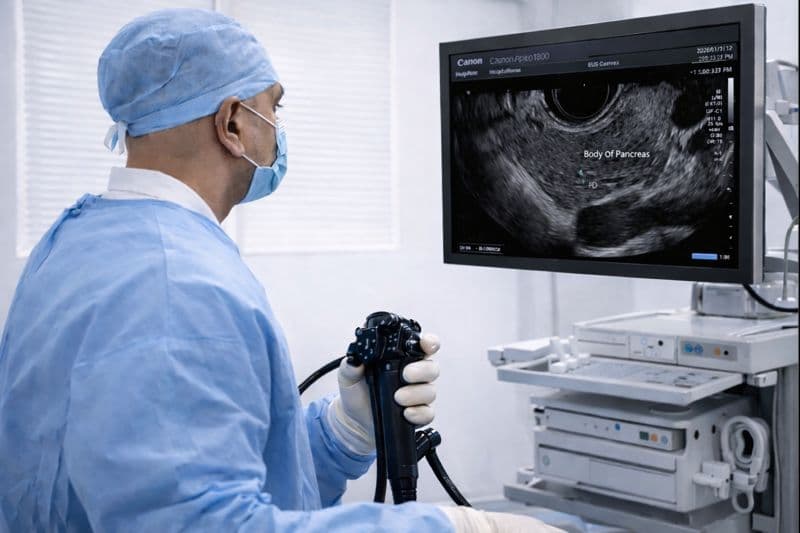
Endoscopic Ultrasound
(EUS)
Endoscopic Ultrasound combines endoscopy with high-frequency ultrasound to obtain detailed images of the digestive tract and surrounding organs. It provides superior imaging of the pancreas, bile ducts, and deep structures that cannot be adequately visualised by other methods.
Book a ConsultationWhat is Endoscopic Ultrasound?
EUS uses a special endoscope with an ultrasound probe at its tip. When positioned in the stomach or duodenum, the ultrasound waves can image structures that are very close to the GI tract, including the pancreas, bile ducts, gallbladder, liver, and surrounding lymph nodes.
Because the ultrasound probe is inside the body and close to these organs, EUS provides high-resolution images of internal structures. This is utilized for the detection of small lesions and for accurate cancer staging.
Diagnostic Indications
- Staging of oesophageal, gastric, pancreatic, and rectal cancers
- Evaluation of pancreatic cysts and masses
- Assessment of bile duct abnormalities
- Investigation of submucosal GI tumours
- Evaluation of chronic pancreatitis
- Detection of small gallstones missed by other imaging
- Assessment of lymph nodes for staging or biopsy
Therapeutic Applications
Beyond diagnosis, EUS enables a range of targeted therapeutic procedures guided by real-time ultrasound imaging.
EUS-Guided Fine Needle Aspiration (FNA)
Sampling of pancreatic masses, lymph nodes, and other lesions for cytological diagnosis.
EUS-Guided Fine Needle Biopsy (FNB)
Core tissue sampling for histological diagnosis, particularly useful for certain tumour types.
EUS-Guided Drainage
Drainage of pancreatic pseudocysts and walled-off necrosis through the stomach wall.
Coeliac Plexus Block/Neurolysis
Pain management for patients with chronic pancreatitis or pancreatic cancer.
EUS-Guided Biliary Drainage
Alternative drainage route when ERCP is not possible or has failed.
EUS imaging of pancreatic structures
EUS-guided Fine Needle Aspiration (FNA)
Advantages of EUS
High-resolution imaging of structures close to the GI tract
Ability to visualise and biopsy lesions not accessible by other methods
Real-time guidance for targeted needle placement
No radiation exposure (unlike CT scans)
Can be combined with ERCP for thorough clinical evaluation
Minimally invasive alternative to surgical biopsy
What to Expect
EUS is performed under sedation, similar to a gastroscopy. The procedure typically takes 30-60 minutes depending on the complexity and whether biopsies are performed.
- Preparation: Fasting for at least 6 hours before the procedure
- During: You will be sedated and comfortable throughout
- After: Rest in recovery until sedation wears off (1-2 hours)
- Results: Imaging findings are usually discussed the same day; biopsy results take several days
Frequently Asked Questions
Common questions about EUS and what to expect.
Specialized EUS Services
If you have been referred for EUS or have a pancreatic or biliary condition requiring detailed evaluation, schedule a consultation to discuss your needs.
Disclaimer: The information provided on this page is for educational purposes only and is not intended as a substitute for professional medical advice, diagnosis, or treatment. Always seek the advice of your physician or other qualified health provider with any questions you may have regarding a medical procedure.