Pancreatic Cysts Specialist in Singapore
Pancreatic cysts are increasingly detected with modern imaging. While most are benign, some carry malignant potential. Specialized evaluation and appropriate surveillance are essential for safe, evidence-based management.
Book a Consultation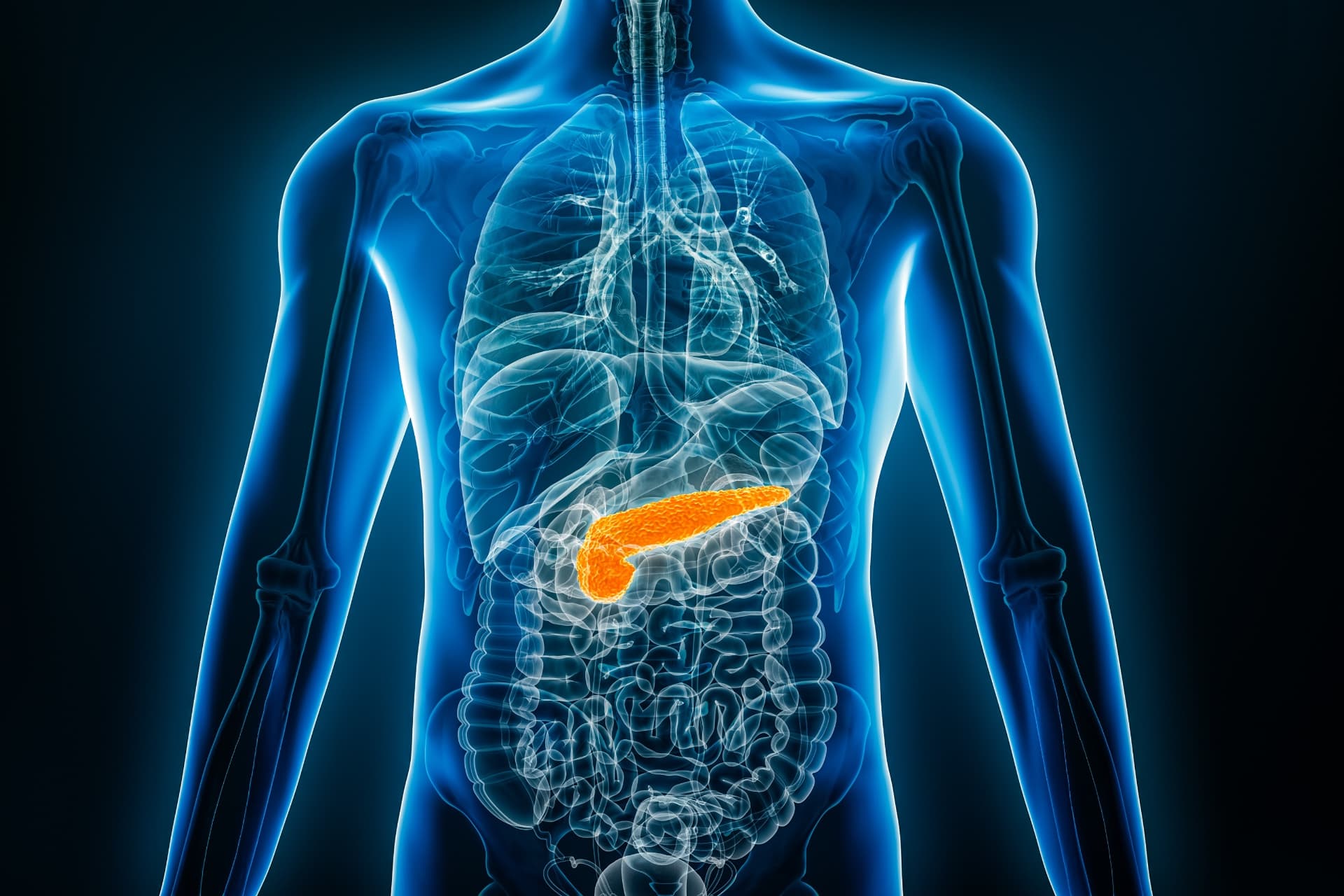
Understanding Pancreatic Cysts
Pancreatic cysts are fluid-filled sacs within the pancreas. They are found in approximately 2-3% of abdominal imaging studies and become more common with age. The key challenge is distinguishing benign cysts from those with malignant potential, as some can progress to pancreatic cancer if left untreated.
Accurate characterisation requires a combination of imaging, cyst fluid analysis, and clinical assessment. Dr. Prem, a Pancreatic Cysts Specialist, offers comprehensive evaluations based on the latest international guidelines to determine optimal surveillance intervals or intervention needs.
Types of Pancreatic Cysts
Intraductal Papillary Mucinous Neoplasm (IPMN)
Risk: Moderate to HighThe most common type, arising from the pancreatic duct. Can be main-duct, branch-duct, or mixed type with varying malignant potential.
Mucinous Cystic Neoplasm (MCN)
Risk: Moderate to HighOccurs predominantly in women, typically in the body or tail of the pancreas. Has malignant potential and often requires surgical resection.
Serous Cystadenoma
Risk: Very LowBenign tumours with very low malignant potential. Often discovered incidentally and can be monitored safely.
Pseudocyst
Risk: None (Non-neoplastic)Non-neoplastic fluid collections that develop after pancreatitis. May resolve spontaneously or require drainage.
Risk Assessment
International guidelines identify specific features that increase concern for malignancy. These guide the intensity of surveillance and need for further evaluation.
Worrisome Features
Presence of these features warrants closer surveillance or further evaluation with EUS.
- Cyst size ≥3 cm
- Thickened or enhancing cyst wall
- Main pancreatic duct 5-9 mm
- Non-enhancing mural nodule
- Abrupt change in duct calibre with distal atrophy
- Lymphadenopathy
- Elevated CA 19-9 levels
- Rapid cyst growth (>5 mm in 2 years)
High-Risk Stigmata
These features indicate a high likelihood of malignancy and typically require surgical evaluation.
- Obstructive jaundice with cystic lesion in pancreatic head
- Enhancing solid component within cyst
- Main pancreatic duct ≥10 mm
A Cyst Was Found on My Pancreas. What Happens Next?
Finding a cyst doesn't mean you have cancer.
Most pancreatic cysts found by accident during a scan are harmless. But some do need monitoring — so it's always worth getting it checked properly. This guide explains what to expect.
The scan found a cyst on my pancreas — what should I do?
Finding a cyst in your pancreas on a scan done for another reason is actually quite common. Most people who discover this feel worried — which is completely understandable. But here's the important thing to know:
Most incidental pancreatic cysts are benign (not cancer).
They are found by chance during CT or MRI scans done for other reasons like back pain, kidney stones, or abdominal discomfort. The large majority never cause any problems.
What you should do next
- Ask your doctor for a copy of the scan report
- Find out whether the radiologist (the specialist who reads scans) recommended any follow-up
- Ask for a referral to a specialist — either a gastroenterologist (gut specialist) or an HPB surgeon (liver, pancreas and bile duct surgeon)
- In Singapore, these specialists are available at SGH, NUH, NCCS, Tan Tock Seng Hospital, and private hospitals
- Do not search online late at night — most of what you will find refers to the worst-case scenarios, not the most common ones
What kind of cyst might it be?
There are several types of pancreatic cysts. Most are identified by their appearance on a scan. Your specialist may recommend an additional scan or a procedure called an endoscopic ultrasound (EUS) to get a clearer picture.
| Type of cyst | What it means for you |
|---|---|
| Serous cyst (SCA) | Almost always harmless. Usually just watched over time. |
| Mucinous cyst (MCN) | Small risk of change over time. May need monitoring or, rarely, removal. |
| IPMN (a type of cyst connected to the pancreatic duct) | Risk varies. Most are low-risk but need regular check-ups. |
| Pseudocyst (from past pancreatitis) | Not a true cyst — harmless and often goes away on its own. |
| Solid pseudopapillary neoplasm (SPN) | Rare. Usually recommended for removal in otherwise healthy patients. |
Are there signs I should be seen sooner rather than later?
In most cases, your specialist will arrange a follow-up scan in 6-12 months. But certain signs — either on the scan or in how you're feeling — mean you may need to be seen sooner or have further tests done.
Tell your doctor straight away if you have:
- New or worsening pain in your upper abdomen or back
- Yellowing of your skin or eyes (jaundice)
- Unexplained weight loss
- New diabetes or your blood sugar suddenly becoming harder to control
- Feeling full quickly when eating, or ongoing nausea
Do not wait for your next routine appointment if you develop any of these symptoms.
Contact your doctor or specialist promptly. These symptoms do not automatically mean something serious, but they need to be assessed.
What scan features concern specialists?
When your doctor looks at the scan report, they look for certain features that can indicate a higher risk. You don’t need to understand all of these — but here is a plain-language summary:
| What the scan shows | Why it matters | What it means |
|---|---|---|
| A solid lump or nodule inside the cyst | Could be an early sign of cancer developing | See a specialist soon |
| The main duct (drainage tube) of the pancreas is wider than usual | Associated with a higher-risk type of cyst | See a specialist soon |
| The cyst has grown noticeably since the last scan | May indicate a change in behaviour | Watch more closely |
| The cyst wall looks thick or irregular | Can be a worrisome feature | Watch more closely |
| The cyst is larger than 3 cm | Requires more careful evaluation | Watch more closely |
| Small, simple, and stable cyst | Very low risk — typical finding | Routine check-ups |
Do I need an operation, or just regular check-ups?
This is the question most patients ask. The honest answer is: it depends on the type of cyst, what it looks like on scans, how it changes over time, and your overall health. Surgery is not needed for most people.
Most people will just need regular monitoring (surveillance)
Monitoring usually means repeat MRI or CT scans every 6–12 months to check that nothing has changed. Over time, if everything remains stable, the gap between scans is often extended.
- Small, stable cysts with no concerning features are usually just watched over time
- Serous cysts (SCA) rarely need surgery — routine imaging is usually all that is needed
- If you have other health conditions that make surgery risky, monitoring is often the right choice even for larger cysts
- You will not be abandoned — regular follow-up is active, protective care, not just waiting
Most people will just need regular monitoring (surveillance)
- The scan shows a solid lump or nodule growing inside the cyst
- The pancreatic duct is significantly widened
- You have developed jaundice linked to the cyst
- The cyst is causing pain, blockage, or other symptoms
- The cyst is a type known to carry a higher risk of becoming cancerous
- You are young and fit, and your doctor feels removal now prevents a bigger problem later
What questions should I ask my specialist?
What type of cyst do I have? • What is my risk of it becoming cancer? • How often do I need scans? • What changes should prompt me to call you? • Will I need surgery, and if so, when?
What type of scan will I need for follow-up?
- MRI (with MRCP): This is the preferred scan for follow-up. It gives excellent detail without radiation and is particularly good at showing the pancreatic ducts.
- CT scan: Used when MRI is not possible. Involves a small amount of radiation.
- Endoscopic ultrasound (EUS): A camera passed gently through your mouth while you are sedated, with an ultrasound probe at the tip. Gives very detailed images and allows your doctor to take a small fluid sample from the cyst if needed.
Can I stop having scans eventually?
Yes — in many cases, your specialist will recommend stopping surveillance if your cyst has been completely stable for several years, or if your age or health means that the result of further monitoring would not change your care. This is a decision made together with you.
How Are Pancreatic Cysts Diagnosed and Monitored?
You don’t need to be a doctor to understand your own care.
This guide explains the scans used to look at pancreatic cysts, what your doctor is looking for, and how they decide how often you need to come back. The more you understand, the easier it is to ask the right questions.
What scans are used, and what does each one actually do?
When a cyst is found on your pancreas, your doctor needs to get a clearer picture of what kind of cyst it is and whether anything about it needs closer attention. There are two main tools used for this: a special type of MRI scan, and a procedure called an endoscopic ultrasound. They are used at different stages and for different reasons.
The MRI scan (and something called MRCP)
An MRI uses magnets and radio waves to build detailed images of your organs. It does not use radiation, which is one reason it is preferred for follow-up over many years.
When your doctor asks for a 'pancreatic protocol MRI' or an 'MRCP', they are asking for a version of the scan that is specially designed to look at the pancreas and the ducts (tubes) that drain it. MRCP stands for Magnetic Resonance Cholangiopancreatography — a long word that simply means a detailed map of the drainage tubes in and around your pancreas and liver.
What is the MRCP actually looking at?
The pancreas has a main drainage duct running through it, like a channel. If a cyst is pressing on this duct, or connected to it, or causing it to widen, that changes how your doctor manages things. The MRCP shows this clearly — better than a regular CT scan.
What can MRI and MRCP tell your doctor?
- The size and shape of the cyst, and whether it has changed since the last scan
- Whether the cyst has any solid areas or nodules growing inside it (a feature that warrants closer attention)
- Whether the cyst is connected to the main pancreatic duct
- Whether the main duct has become wider than normal — this can indicate a higher-risk type of cyst
- The number of cysts and where in the pancreas they sit (head, body, or tail)
What an MRI cannot always tell your doctor
MRI is excellent for the big picture, but it has limits. It can struggle to pick up very small nodules inside a cyst, and it cannot directly sample the fluid inside the cyst to test it. That is where the second tool comes in.
The endoscopic ultrasound (EUS) — a closer look
An endoscopic ultrasound is a procedure done while you are sedated (lightly asleep). A thin, flexible tube is passed gently through your mouth and down into your stomach. At the tip of the tube is a tiny ultrasound probe, which sends sound waves to create detailed images of the pancreas from the inside — much closer than any external scan can get.
It sounds more daunting than it is. Most patients find it completely manageable, and you are kept comfortable throughout with sedation. The whole procedure usually takes 20 to 40 minutes.
Why is getting closer such an advantage?
The pancreas sits deep in the abdomen, surrounded by other organs. An external ultrasound or even a CT scan has to look through layers of tissue. An EUS probe sits right next to the pancreas with only the stomach wall in between. This gives images that are far more detailed for small features like nodules or wall thickening inside a cyst.
What can an EUS tell your doctor?
- A much more detailed look at the internal structure of the cyst — especially small nodules or thickening that an MRI might miss
- Whether a nodule inside the cyst is truly solid (higher concern) or just a fold of tissue (less concern)
- The exact relationship of the cyst to nearby blood vessels and the pancreatic duct
- A sample of cyst fluid, if needed, by passing a fine needle through the scope (called EUS-FNA) — this fluid can be tested to help identify the type of cyst and its risk
How does cyst fluid testing help?
The fluid inside different types of cysts has different characteristics. Measuring the level of a substance called CEA (carcinoembryonic antigen) in the fluid can help distinguish between a mucinous cyst — which carries a small but real risk — and a non-mucinous cyst, which is almost always benign. The fluid can also be tested for unusual cells. This is most useful when the scan picture is unclear and your specialist needs more information before deciding on a management plan.
MRI vs EUS at a glance
| MRI / MRCP | Endoscopic ultrasound (EUS) | |
|---|---|---|
| How it's done | You lie in a scanner for 30–45 minutes. No needles. | You are sedated. A flexible scope is passed through your mouth. |
| What it's best for | Regular follow-up, showing the whole pancreas and ducts, detecting size changes over time. | Detailed look at a specific cyst, detecting small nodules, sampling cyst fluid. |
| Does it use radiation? | No | No |
| Can it sample fluid? | No | Yes, if needed |
| When is it used? | First-line for most follow-up. | When MRI is unclear or a tissue/fluid sample is needed. |
How does my doctor decide how often I need to come back?
One of the most common questions patients ask is: “How often do I really need these scans?” The answer is not the same for everyone. Your specialist will look at several factors together to decide on the right interval for you personally.
The things your doctor weighs up
- What type of cyst it is — some types are inherently lower risk and need less frequent checks; others are watched more carefully
- How big the cyst is — larger cysts are generally monitored more closely, at least initially
- Whether the cyst has changed — a cyst that has been completely stable for several years is less worrying than one that has grown
- Whether there are any concerning features — things like nodules, duct widening, or thickened walls change the timing of follow-up
- Your age and general health — a younger, fit patient may need longer follow-up; for older patients with other health conditions, the balance of benefit shifts
- How you are feeling — if you develop new symptoms, the interval may be shortened or a different test arranged regardless of the schedule
Follow-up is not one-size-fits-all.
International guidelines give doctors a framework, but your specialist will adapt this to your specific cyst and your overall situation. If your interval feels too long or too short for your comfort, it is always reasonable to ask your doctor to explain their reasoning.
Typical follow-up intervals as a rough guide
The table below gives a general sense of how intervals are typically set. Your own schedule may differ based on the specifics of your case.
| Situation | Typical scan interval | Type of scan usually used |
|---|---|---|
| Small, simple cyst with no concerning features (< 1.5 cm) | Every 1–2 years | MRI / MRCP |
| Cyst 1.5–3 cm, stable, no worrisome features | Every 6–12 months initially, then annually if stable | MRI / MRCP |
| Cyst > 3 cm or with worrisome features | Every 3–6 months | MRI ± EUS |
| After surgery, to check for recurrence | Varies — discuss with your surgeon | MRI or CT |
| Very stable cyst in older patient after many years | May be extended or stopped | Discuss with specialist |
Can my follow-up interval change over time?
Yes, and this is actually a good sign. If your cyst remains completely stable over several years with no concerning features, your specialist will often extend the gap between scans. This is not them losing interest in your care — it reflects the fact that stable cysts over time carry a lower risk, and the benefit of very frequent scanning starts to diminish.
On the other hand, if something changes — the cyst grows, a new symptom appears, or a scan shows a new feature — your interval will be brought forward and your doctor may arrange an EUS or refer you to a surgeon.
Do not wait for your next scheduled scan if you develop new symptoms.
New abdominal or back pain, jaundice (yellowing of the skin or eyes), unexplained weight loss, or a sudden change in how you feel should prompt you to contact your specialist promptly — do not wait for the next routine appointment.
A note on radiation and scan safety
Many patients worry about the cumulative effect of repeated scans. MRI does not use radiation at all, which is one reason it is the preferred tool for long-term cyst monitoring. CT scans do involve a small amount of radiation, but they are used selectively. Your doctor will always try to choose the scan that gives the most useful information with the least burden to you.
Investigations
Comprehensive evaluation combines imaging and, when indicated, cyst fluid analysis.
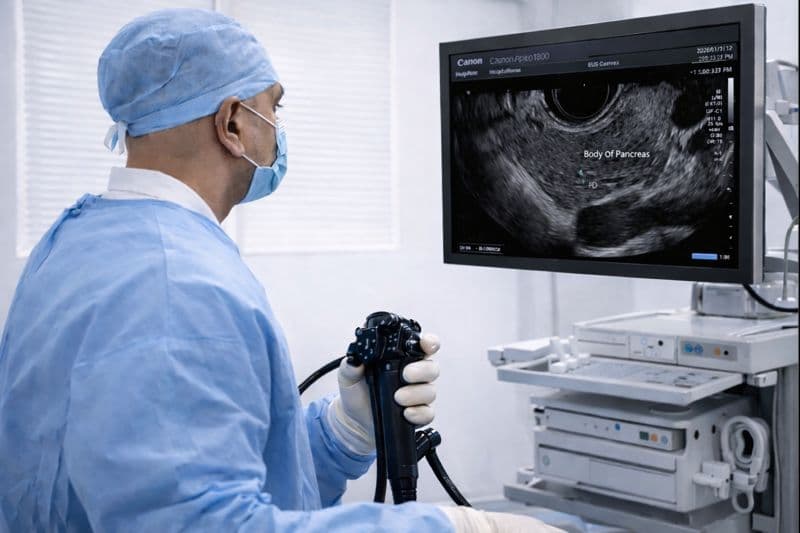
EUS with FNA
Endoscopic ultrasound provides high-resolution imaging of pancreatic cysts and allows cyst fluid sampling.
- Detailed cyst characterisation
- Detection of mural nodules
- Cyst fluid analysis (CEA, amylase, cytology)
- Molecular markers for malignancy risk
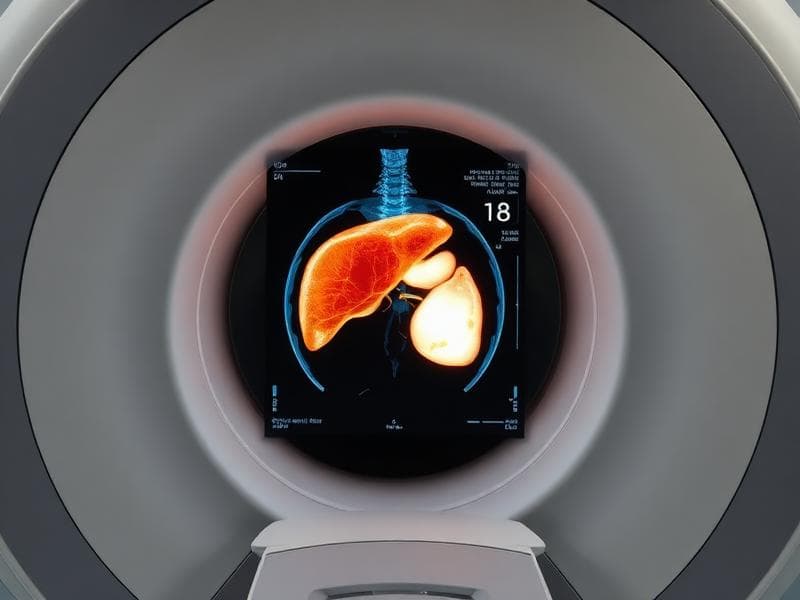
MRI/MRCP Surveillance
MRI with MRCP is the preferred imaging modality for surveillance, avoiding radiation exposure.
- No radiation exposure (safe for repeated imaging)
- Clear soft tissue characterisation
- Visualises pancreatic duct communication
- Tracks cyst size changes over time
Management Approach
Management is individualised based on cyst type, size, features, and patient factors. Options range from surveillance to surgical resection.
Surveillance
Regular MRI/MRCP imaging at intervals determined by cyst characteristics. Most low-risk cysts can be safely monitored without intervention.
Enhanced Surveillance
More frequent imaging and EUS evaluation for cysts with worrisome features. Allows early detection of concerning changes.
Surgical Referral
For high-risk cysts, surgical resection is a primary clinical objective for high-risk cases. Coordinated referral to experienced pancreatic surgeons when indicated.
Frequently Asked Questions
Clinical Management of Pancreatic Cysts
Dr. Prem provides comprehensive evaluation and ongoing surveillance of pancreatic cysts, using the latest international guidelines to ensure safe, evidence-based care.
Related Conditions
You may also be interested in learning about these related conditions.